Why everyone else’s insomnia recovery seems easier than yours
I often hear something along these lines:
“All those people from success stories had it so easy. Just a couple of months – and they recovered! And here I am: learning this for months and months, and I’m nowhere near where they are. I’ve never had my breakthrough. I think my insomnia is somehow special. Maybe I’m simply resistant to recovery. Maybe I’ll never get out of it…”
If you recognize yourself in this, I want to dispel some of the myths about recovery stories, help you see that you might not be as far away from recovery as you think, and show you how to support yourself when it seems like everyone around you is doing better.
Success stories are helpful until…
When we first begin our insomnia recovery journey, seeing someone share their success can become a light at the end of the tunnel. Their story can give us hope, strength and inspiration to embark on our own journey. It’s simply beautiful.
It helps a lot to know that we aren’t alone and that our experiences aren’t as unique and weird as we thought they were. Especially if we find someone with a similar background or personality talking about how they “got there.”
“If it was possible for her, it must be possible for me too, yay!”
But at some point, we may turn into a “success story junkie” and binge-watch nearly all of them. At the same time, we keep living our own journey, with its rough patches and doubts. And whether we want to or not, we begin comparing ourselves to others.
And we start asking questions:
- Why am I not there yet? What’s taking me so long?
- I’ve been stagnating for such a long time and nothing seems to change. How did those people make it?
- I’ve wasted so much time. Where are my breakthroughs?
- He said he did X and Y happened. I did the same thing with no effect. Why?
- I hate that this seems so easy for everyone else but me!
So every time we watch another success story, it’s no longer an uplifting and inspiring message. Instead, it becomes a reminder of how “terrible” and “hopelessly stuck” we are.
And I’m not putting words into your mouth here. I’m describing my own feelings when I oversaturated myself with stories of success. Some of you might experience these feelings too.
What is success story fatigue and how can we recognize it?
Everything is fine in moderation, and success stories are no exception.
When we keep absorbing all the information people share, the brain can switch into turbo mode where it tries to apply all the insights from all the stories at once. And when that happens, things get challenging.
Each story took time to unfold, but our brain wants to fit all of it into one session.
To quickly check whether you might have had a little too much, simply notice your inner state before and after you watch or read a success story.
- Do you feel more confused after watching it than before?
- Do you feel more pressured to recover?
- Do you feel worse about yourself in comparison to others?
- Do you analyze and overthink more afterward?
These can be pretty good signs that you might need some rest from them.
The truth about success stories
There is another problem with comparing our recovery to someone else’s:
Success stories are condensed.
People who watch a success story may form a very different picture from what that person’s recovery actually looked like. From the outside, it often seems easier, smoother, faster.
A lot of things get omitted – not intentionally, but simply because that’s how storytelling works. The boring, uneventful and unsuccessful parts of the journey usually aren’t given much attention. The most memorable parts become the highlights.
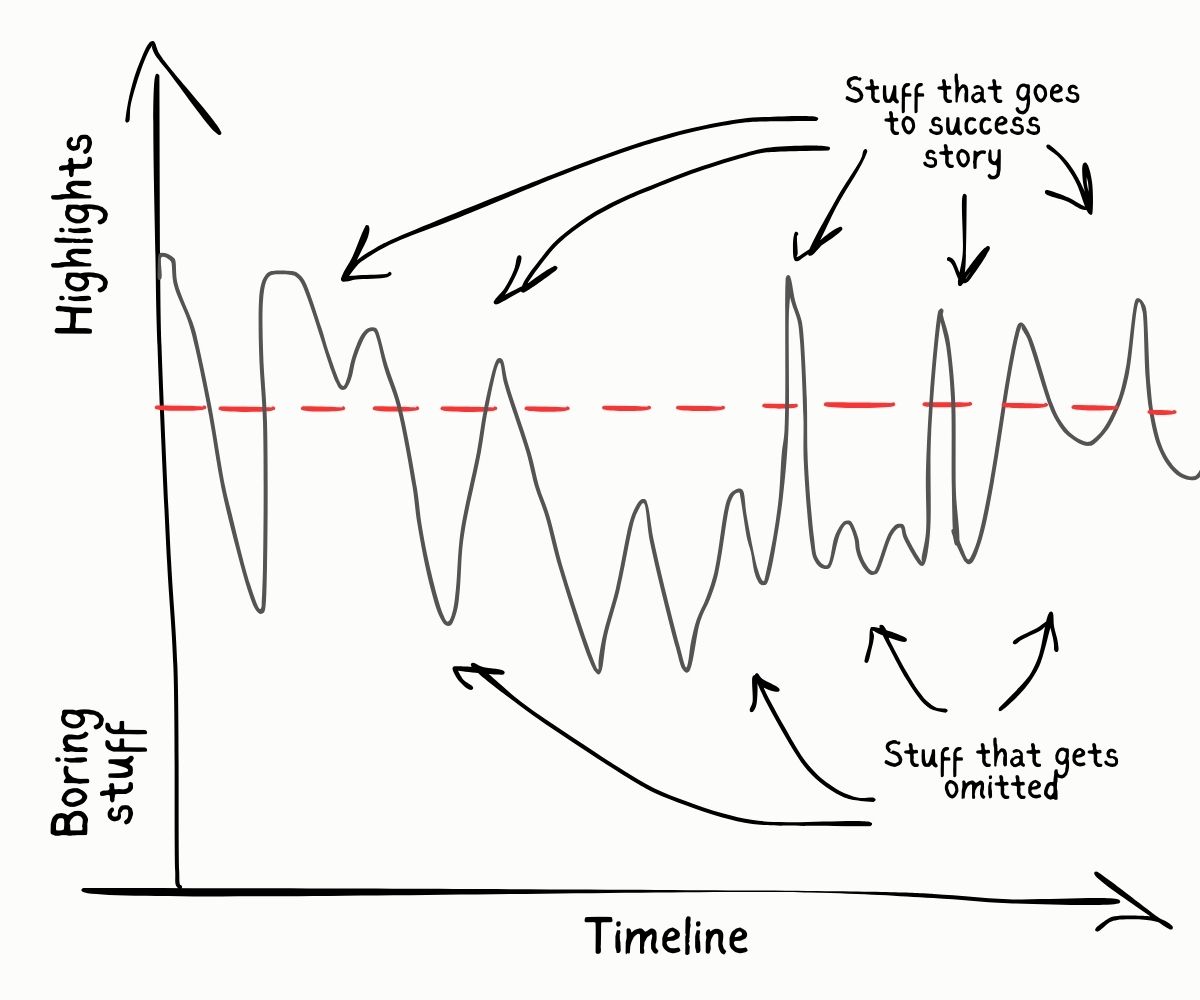
Telling a success story is like meeting a school friend on the street after 15 years of not seeing each other and having to answer the question: “So, what’s new?”
Keep this in mind: success stories are a very, very condensed version of the journey.
What we typically hear:
A story of how insomnia started → The darkest moments → Trying X, Y, Z. Not succeeding. → Finding the teachings and getting inspired, learning. → ✨Magic✨ → “It all started to make sense!” → “My sleep got better!” → “Here are my insights…” → “I no longer care whether I sleep or not! Life is great!”
What is typically omitted:
- Finds a teaching, gets inspired and then fear comes back → Desperation: “It’s hopeless!” → Reassurance seeking: “I need to know this will work!!!”
- Starts to sleep better but doesn’t know how it happened → Tries to maintain it, but hits a setback: “Oh no, I had it and I lost it!” → Panicky attempts to get back the understanding they had initially, but ends up going deeper into the rabbit hole.
- “I don’t get it anymore! Screw this, I give up.” → Sleep gets a bit easier → “Is this a joke??”
- “Okay, I think I’m getting it…” → 5 minutes later: “Oh no! I don’t get it anymore! How could I forget what I just learned? Nothing makes sense again!!” → “Wait, I think I get it…” → “Nope, I forgot it again.” → panic
- “I’m not making any progress. All the good stretches I had weren’t real recovery, I was just fooling myself.”
- Things are getting better, but not as good as they would like. Stuck in “not great, not terrible” → Tries to fix it and get unstuck → Starts sleeping even worse → “What have I done?? I wish I could go back to that ‘not great, not terrible’ place.” → Gives up, cries → At some point, sleep comes.
- Things are finally going well → Gets cocky and overconfident → Boom, a speed bump → “It’s even worse than before!!”
- Tries to nail the theoretical part → Watches a ton of videos and reads plenty of books → Gets oversaturated and confused → Seeks clarity and reassurance → Has a trillion questions → Everything seems urgent.
- Gets sick and tired of the topic → Unsubscribes from all resources → Feels better after doing this → Eventually has a setback → Resubscribes.
This list might seem pretty detailed – because these are the “boring” and “unsuccessful” parts of my own journey.
In fact, I could go on and on with examples, but I hope you get the idea.
The real journey isn’t just in the highlights, it’s also in the mundane, confusing and sometimes embarrassing moments.
And when you compare your recovery with someone else’s, there’s something fundamentally unfair about the comparison:
You are comparing the full, unedited, present-tense version of your journey with the condensed retrospective version of theirs. And of course theirs looks smoother.
When success stories stop helping
I hope you can now see some of the illusion our minds can construct around a success story.
Being in one of those boring, confusing stretches doesn’t necessarily mean you’re hopelessly stuck while everyone else is moving forward. You might simply be living through the parts that rarely make it into the final storytelling.
And if consuming success stories repeatedly leaves you feeling worse about your own recovery, you don’t have to keep consuming them.
Success stories can serve a beautiful purpose: “This is possible. Someone else has been here too.” But once they become something we use to measure ourselves against, analyze our progress, hunt for the missing insight or figure out why somebody else “got it” and we haven’t, they may no longer be serving that purpose.
Taking a vacation from them can be a good idea.
Out of sight, out of mind, so to speak.
Be fair to yourself
What I learned from my own experience with envy and self-judgment is that the moments when we feel like we’re doing worse than everyone else are often the moments when we need self-kindness the most.
When we compare our journey with someone else’s, we can be utterly unfair and mean toward ourselves. For all the hard work we’ve put into this, instead of validation and recognition, we kick ourselves.
- Why aren’t you there yet?
- Why haven’t you figured this out?
- Why is everyone else better at this than you?
But we don’t actually know that! We don’t know what somebody’s ordinary day looked like.
So if success stories are making you feel pressured, inadequate or hopeless, give yourself some space from them. Focus on your own life for a while. Forget about the things that currently make no sense, or leave them for another time. Ask yourself regularly: “What would feel like self-kindness for me right now?”
And perhaps remember this the next time somebody tells you their beautifully condensed recovery story: you’re hearing their highlights while living your own behind-the-scenes.